China Top 10 Industrial Power Supply Manufacturers?
China has become a major source of reliable Industrial Power Supply equipment for factories, data centers, transportation systems, and renewable energy projects. Its manufacturers serve both domestic and international markets, combining large-scale production with increasingly specialized engineering. However, “top” should not mean the biggest name alone.
This guide introduces ten leading Chinese manufacturers and examines their practical strengths. The comparison considers product range, output stability, safety certifications, customization ability, technical support, and export experience. It also looks at switching power supplies, DIN rail units, industrial UPS systems, battery chargers, and high-power DC solutions. Real factory conditions matter. Heat, dust, voltage fluctuations, and limited maintenance access can expose weak designs quickly.
Not every manufacturer fits every project. Some companies excel in automation, while others focus on communication equipment, medical systems, or energy storage. Certification lists can also change, and published specifications may not reveal long-term field performance. That deserves careful checking. Buyers should request test reports, warranty terms, sample units, and references from comparable installations.
The companies discussed here are selected through a balanced, evidence-based approach. Their reputations, engineering capabilities, production controls, and customer support all deserve attention. Still, this overview is not a substitute for technical validation. A power supply that performs well in a clean laboratory may struggle beside a high-temperature motor drive. Good selection requires matching the manufacturer’s proven experience with the application’s actual electrical and environmental demands.
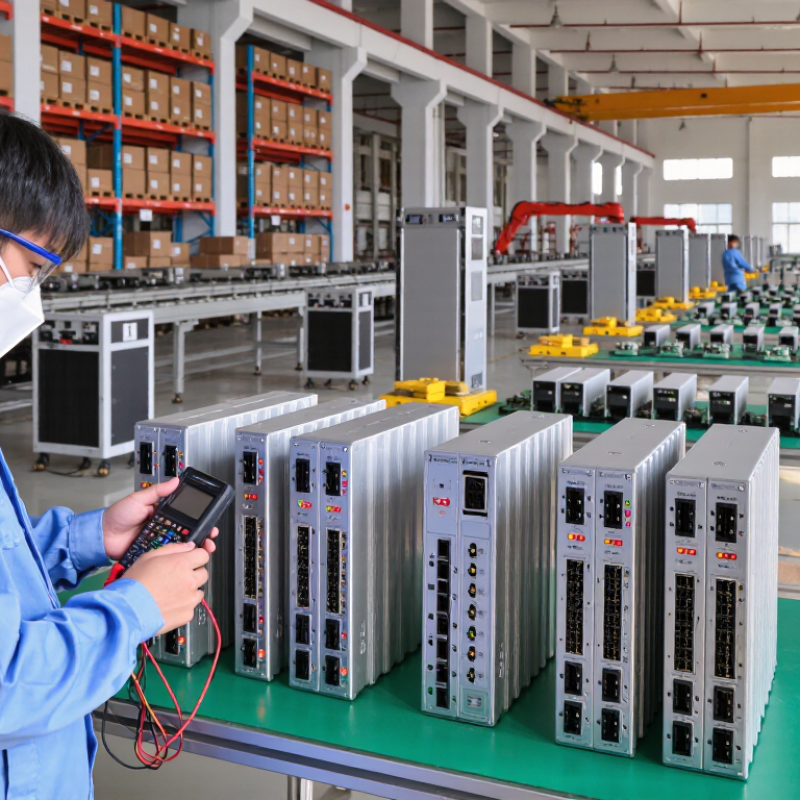
China’s Industrial Power Supply Market: 2024 Size, Growth, and Key Segments
China’s industrial power supply market remained a multi-billion-dollar sector in 2024, although published estimates vary by scope and currency. Most reports indicate steady growth, supported by factory automation, renewable energy equipment, electric transport, and expanding data centers. Growth is not uniform. Demand is strongest for compact AC-DC converters, reliable DC-DC modules, programmable supplies, UPS systems, and high-power units for industrial cabinets.
A practical top-ten manufacturer review should examine more than production volume. Check safety certifications, output stability, thermal design, delivery records, and technical support. In a real cabinet, a few degrees of extra heat can shorten component life. Ripple performance also matters when sensors, controllers, and communication devices share a 24-volt rail. Field experience shows that a low purchase price can become expensive after repeated failures. Still, rankings can be imperfect because company data, regional sales, and private-label production are often difficult to verify.
Tips: Compare efficiency at partial load, not only at full load. Request test reports and sample units before large orders. Confirm warranty terms, repair procedures, and replacement stock. Consider humidity, dust, vibration, and ambient temperature at the installation site. A supply rated for laboratory conditions may struggle inside a crowded factory cabinet. That detail is easy to miss.
China Top 10 Industrial Power Supply Manufacturers? - China’s Industrial Power Supply Market: 2024 Size, Growth, and Key Segments
| No. | Key Market Segment | Typical Industrial Application | Common Product Form | Typical Output Range | Main Technical Priorities | 2024 Market Relevance |
|---|---|---|---|---|---|---|
| 1 | Industrial Automation Power Supplies | PLC systems, sensors, actuators, control cabinets and factory automation equipment | DIN-rail and panel-mount AC/DC supplies | 24 V DC; approximately 30 W–1 kW per unit | High reliability, narrow profile, overload protection and EMC performance | Supported by continued investment in factory automation and smart manufacturing |
| 2 | Industrial Control and Embedded Power | Machine controllers, industrial computers, measurement systems and embedded equipment | Board-level AC/DC, DC/DC and enclosed power modules | 5 V, 12 V, 24 V and 48 V DC; below 1 kW is common | Compact design, thermal management, isolation and long service life | Demand follows the expansion of digitalized production lines |
| 3 | Motor Drives and Motion-Control Power | Variable-frequency drives, servo systems, robotics and production machinery | AC/DC front ends, auxiliary supplies and regenerative power units | Auxiliary supplies from tens of watts to several kilowatts | Power quality, braking energy management, cooling and vibration resistance | Linked to energy-efficiency upgrades and automation of discrete manufacturing |
| 4 | Telecom and Industrial Network Power | Industrial Ethernet, wireless infrastructure, base-station equipment and edge-network cabinets | 48 V DC rectifiers, converters and rack-mounted systems | 48 V DC; cabinet systems from hundreds of watts to tens of kilowatts | High availability, remote monitoring, surge protection and battery integration | Benefited from industrial connectivity, edge computing and network upgrades |
| 5 | Uninterruptible Power Supply Systems | Control rooms, data processing, precision manufacturing and critical industrial loads | Standby, line-interactive and online double-conversion UPS | From below 1 kVA to multi-megavolt-ampere systems | No-break transfer, battery management, power factor and bypass design | Demand is reinforced by data-center construction and industrial continuity requirements |
| 6 | Energy-Storage and Battery-Charging Power | Battery production, warehouse vehicles, industrial energy storage and charging infrastructure | Bidirectional converters, chargers and power-conversion cabinets | Several kilowatts to hundreds of kilowatts per cabinet | Efficiency, thermal control, isolation, protection and battery communication | Supported by China’s expanding battery, electric-vehicle and energy-storage industries |
| 7 | Renewable-Energy Conversion Power | Solar inverters, wind-power converters and distributed-energy systems | Grid-tied inverters, DC/DC converters and power-conversion skids | Kilowatt-scale distributed units to megawatt-scale systems | Grid compliance, efficiency, harmonic control and environmental durability | High relevance due to continued renewable-generation and grid-integration investment |
| 8 | LED, Display and Machine-Vision Power | Industrial lighting, inspection systems, displays and optical production equipment | Constant-voltage and constant-current AC/DC supplies | 12 V, 24 V, 36 V and 48 V DC; typically below 1 kW | Low ripple, accurate regulation, thermal performance and electromagnetic compatibility | Supported by automated inspection, electronics manufacturing and efficient lighting adoption |
| 9 | Transportation and Charging Infrastructure Power | Rail transit, electric-vehicle charging, signaling and traffic-control systems | Rectifiers, auxiliary converters and high-power charging modules | Hundreds of watts to hundreds of kilowatts | Safety isolation, surge protection, high efficiency and outdoor robustness | Demand is connected with rail electrification and electric-vehicle infrastructure development |
| 10 | Medical and Laboratory Industrial Power | Laboratory instruments, imaging equipment, analytical systems and medical manufacturing | Medical-grade AC/DC and low-noise DC/DC modules | From a few watts to several kilowatts | Low leakage current, isolation, low noise, reliability and regulatory compliance | Supported by laboratory automation, healthcare equipment and high-end manufacturing demand |
| 2024 China market context: China’s total electricity consumption reached approximately 9,852.1 billion kWh in 2024, according to the National Energy Administration, representing year-on-year growth of about 6.8%. Electricity consumption in the secondary industry was approximately 6,374.1 billion kWh. Industrial power supplies are not reported as a standalone category in official national statistics; therefore, this table presents a company-neutral segmentation and engineering reference rather than a manufacturer ranking or an independently verified market-revenue ranking. | ||||||
FAQS
It remained a multi-billion-dollar sector. Published estimates vary because reports use different scopes and currencies.
Factory automation, renewable energy equipment, electric transport, and data centers support demand. Growth is uneven across segments.
Compact AC-DC converters, DC-DC modules, programmable supplies, UPS systems, and high-power cabinet units are widely needed.
Review safety certifications, output stability, thermal design, delivery records, and technical support. Production volume alone is not enough.
A few extra degrees can shorten component life. Crowded cabinets may also reduce airflow and increase operating temperature.
No. Confirm its testing method, temperature, load, and sample size. A large figure may reflect unrealistic laboratory conditions.
Request test reports and sample units. A 72-hour load test may reveal loose terminals, unstable output, or noisy cooling fans.
Check humidity, dust, vibration, and ambient temperature. Laboratory-rated equipment may struggle inside a hot factory cabinet.
Ask for written availability covering samples, pilot orders, and repeat production. Confirm drawings, firmware notes, alarm guidance, and replacement procedures.
Repeated failures create repair delays and replacement costs. I may still overvalue documents without inspecting samples or visiting the factory.
Conclusion
China’s Industrial Power Supply market continues to expand as manufacturers support automation, renewable energy, telecommunications, transportation, and advanced equipment. This article reviews the market’s 2024 development, major application segments, and the capabilities of leading domestic producers across AC-DC converters, DC-DC modules, UPS systems, and industrial inverters. It compares manufacturers by production capacity, energy efficiency, product consistency, customization options, and compliance with key requirements such as IEC 62368-1, electromagnetic compatibility, RoHS, and relevant efficiency benchmarks.
The guide also explains how to evaluate an Industrial Power Supply beyond its purchase price. Important factors include reliability, MTBF, thermal performance, input and output stability, operating temperature and voltage range, delivery lead time, technical support, and after-sales service. By combining market insight with practical selection criteria, the article helps engineers, procurement teams, and system integrators identify suitable power solutions for demanding industrial environments while balancing performance, safety, lifecycle cost, and long-term supply continuity.
